
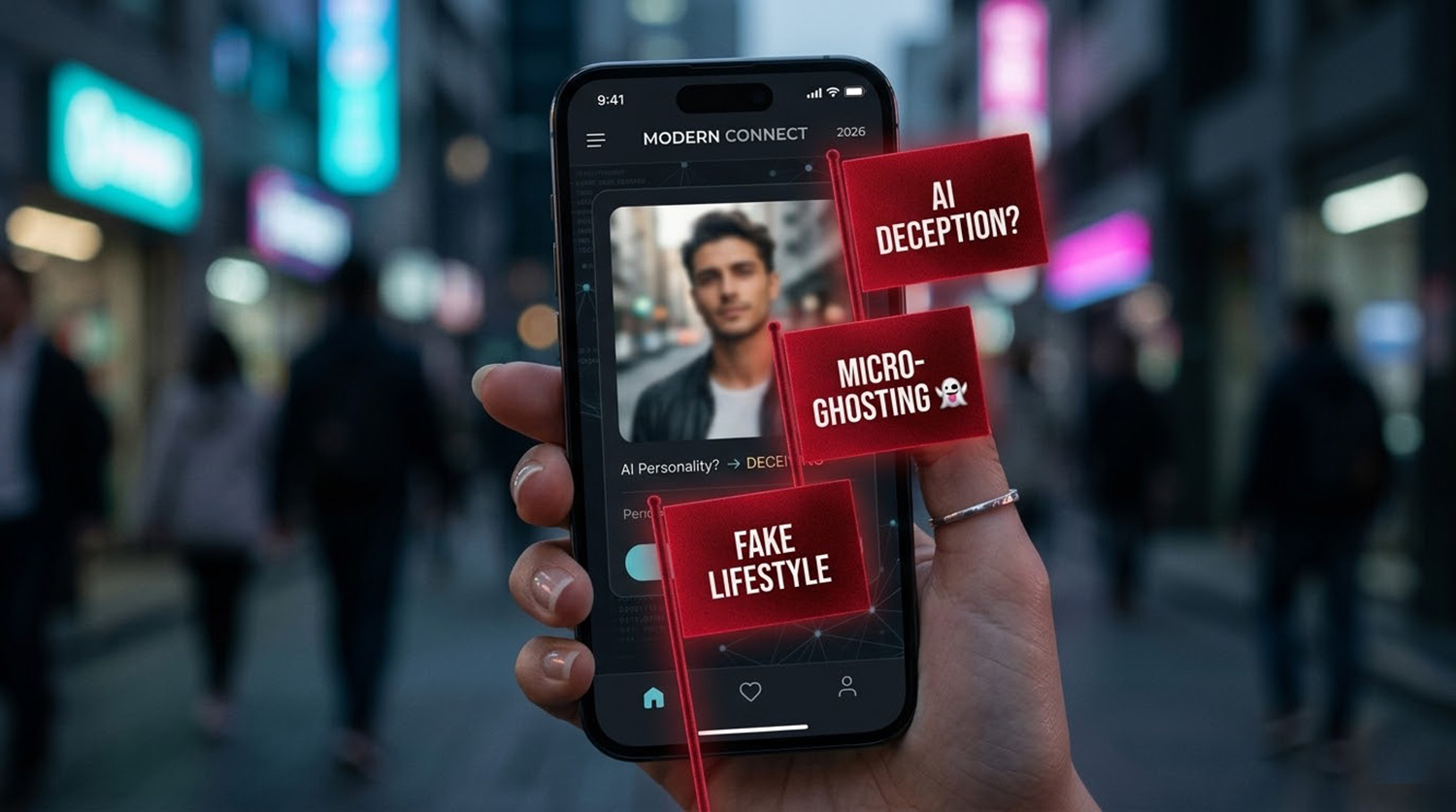
In the rapidly shifting landscape of 2026, the traditional “red flags” we grew up with have evolved. While “rudeness to waiters” is still a valid concern, the digital-first nature of modern romance has introduced a new set of sophisticated warning signs. If you’ve been following our journey through dating after 30, you know that protecting your peace starts with early detection.
Identifying a red flag isn’t about being cynical; it’s about being efficient. In a world of infinite scrolls, your time is your most valuable currency.
1. The “AI-Enhanced” Personality
By 2026, generative AI is integrated into almost every messaging app. A major red flag is a profile or conversation that feels too perfect. If every response is a polished paragraph that lacks human quirkiness, typos, or spontaneous emotion, you might be talking to an LLM-augmented persona rather than a person.
- The Spot: Ask a highly specific, local, or emotional question that requires “lived experience” rather than data processing. If they dodge the nuance, be wary.
- If a match constantly avoids showing their face in real-time, it’s a major red flag. This is why digital pre-dating via a short video call has become a non-negotiable safety standard in 2026.
2. Passive-Aggressive “Micro-Ghosting”
We all know what ghosting is, but 2026 has brought us micro-ghosting. This is when someone stays “active” in your digital life—liking your stories or sending a “hope you’re good” text every 10 days—but never actually commits to a plan.
- The Reality: This is a sign of “benchmarking.” They are keeping you on the sidelines while they scan for other options. It’s a subtle form of emotional unavailability that drains your battery without giving anything back.
3. The “Over-Curated” Lifestyle (The Authenticity Gap)
In an era of deepfakes and high-end filters, a profile that looks like a high-budget travel magazine is often a red flag for insecurity or deception. If there is a massive gap between their digital “vibe” and their actual daily reality, you are dating a brand, not a human.
- The Fix: Look for “low-fi” moments. Does their profile show them in a messy kitchen or a regular t-shirt? If everything is a 4K drone shot, the hardballing clarity you need will be impossible to find.
4. Aggressive “Love Bombing” via Automation
Technology has made love bombing easier. Be careful of someone who uses automated “good morning” triggers or generic compliments that feel scheduled. If the intensity of their digital affection doesn’t match the actual time you’ve spent together, they are likely trying to bypass your natural defenses.
5. Resistance to “Live” Verification
If you’ve been talking for a week and they refuse a quick video call or a voice note, in 2026, this is a non-negotiable red flag. With the rise of sophisticated catfishing, anyone genuine will understand the need for a 60-second “vibe check” before meeting.
6. The “Privacy Wall” as a Weapon
There’s a difference between being private and being secretive. If they have zero digital footprint or refuse to share even basic social connections after several dates, they might be hiding a “situationship” or a lifestyle that doesn’t align with your dating bio goals.
7. Lack of Digital Boundaries
Do they follow every person you interact with on social media? Do they track your “active” status on apps? In 2026, digital stalking is often masked as “being interested.” True connection requires trust, not surveillance.
Conclusion: Trust Your Human Intuition
The tools may change, but your “gut feeling” remains the most advanced algorithm on the planet. If something feels “off” in the digital thread, it usually is. Use these flags not to build a wall, but to build a filter that lets the right people through.
Next Step: Done with the first date? Learn the 24-hour texting rule to keep the momentum alive without the awkward games.